

 Română
 English
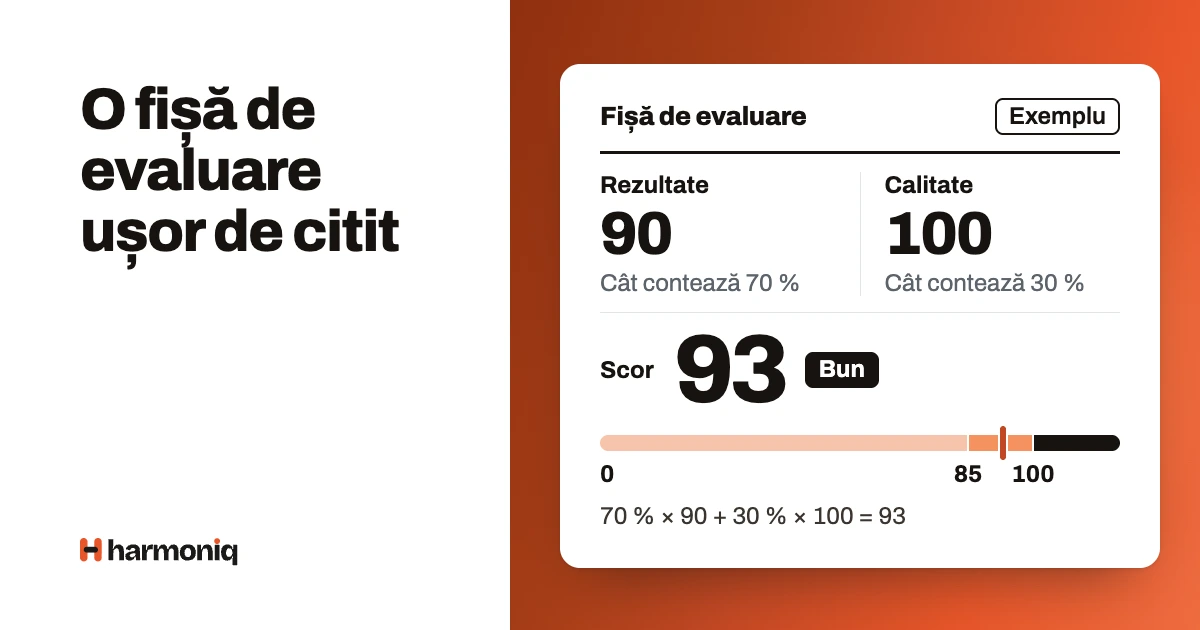
A good employee appraisal form contains four things: quantitative criteria (figures with a target and a source), behavioural criteria described through observable examples, a weight for each criterion and a scale with written rules for turning results into ratings. At the end it has room for the discussion, the plan and the employee’s response.
The article gives you a template filled in with fictitious data, recalculated step by step, two variations that show where a form breaks (a missing figure and a threshold) and the file fisa-de-evaluare.xlsx, with ready-to-use formulas. The spreadsheet itself is in Romanian.
Quick answer. An appraisal form template has six sections: the person’s details and the period, the quantitative criteria with target and actual, the behavioural criteria with observable anchors, the weights adding up to 100%, the 1-to-5 scale with its thresholds, and the sections for discussion, plan and signatures. The final rating is the weighted average of the ratings, turned into a grade according to thresholds set in advance.
What is an appraisal form
The performance appraisal form is the document that records, for one person and one period, the criteria they are assessed against, the result on each criterion, the final rating and the discussion that followed. It differs from the job description: the job description says what the person does, the appraisal form says how well they did it over a period.
- The criterion is one aspect of the work assessed separately: a figure (sales, returns) or a behaviour (serving customers, working with colleagues).
- The weight is how much the criterion counts in the final rating, as a percentage. The weights of all the criteria add up to 100%.
- The scale consists of the possible ratings (here 1–5), each with a name and a description.
- The behavioural anchor is the description of an observable behaviour that corresponds to a rating. The method is known as the behaviourally anchored rating scale (BARS).
- The grade is the name of the band the final rating falls into: “Meets expectations”, “Exceeds expectations”.
What the law requires and what is up to the company
Romania’s Labour Code does not prescribe a form. It does, however, require a few things the form must respect (Law 53/2003, consolidated version on the Legislative Portal, checked on 18 October 2026):
- the employer has the right “to set the individual performance objectives, as well as the criteria for assessing their achievement” (art. 40(1)(f));
- the employee is informed of “the criteria for evaluating the employee’s professional activity applicable at the employer” (art. 17(3)(e));
- the internal regulations contain “the criteria and procedures for the professional evaluation of employees” (art. 242(i));
- dismissal for professional unsuitability (art. 61(d)) may be ordered “only after the prior evaluation of the employee, according to the evaluation procedure laid down in the applicable collective labour agreement or, in its absence, in the internal regulations” (art. 63(2)).
The legal obligation, then, is for the criteria and the procedure to exist, to be written down and to be communicated. The form’s layout, the scale, the weights and the frequency are management decisions. If the form’s result affects pay or may support a dismissal, check the internal regulations and the wording of the form with the company’s lawyer. The template below is meant for private employers; in the public sector, evaluation follows separately regulated procedures.
The form’s six sections
- Identification: the person, the role, the unit, the period assessed, the assessor.
- Quantitative criteria: for each, the target, the actual, the direction (“more is better” or the reverse) and the data source.
- Behavioural criteria: the rating and, without exception, the facts observed that support it.
- Weights and scale: how much each criterion counts and how a result becomes a rating.
- Result: the final rating, the grade and what share of the weight had data.
- Discussion: strengths, what needs to improve, objectives for the next period, the employee’s comment, the date and the signatures.
Quantitative criteria and behavioural criteria
The two kinds complement each other. Figures say what was achieved, behaviours say how. A form with figures only rewards results however they were obtained; one with behaviours only depends entirely on the assessor’s judgement.
| Kind | What it measures | Where the data come from | How it becomes a rating | The main risk |
|---|---|---|---|---|
| Quantitative | Countable results: sales, average transaction, returns, deadlines met | Sales systems, accounts, registers | Actual against target, then a table of thresholds | Figures the person does not control; shortcuts |
| Behavioural | The way the work is done: serving customers, working with colleagues, following procedures | Documented observations, internal checks, concrete examples | The rating chosen by the assessor against written anchors | General impressions, the halo effect, the last week weighing too much |
Assessor errors and how to counter them are covered at length in the article on errors in employee evaluation. On the form, the simplest countermeasure is the “Evidence” field: no behavioural rating without at least one dated fact.
How to set the weights
- Add up to 100%. The form in the downloadable file checks the sum itself.
- Six or seven criteria at most. Below 10%, a criterion no longer changes the final rating and only lengthens the discussion.
- The split between blocks follows the role. For a sales assistant, 60% quantitative and 40% behavioural is a reasonable choice; for a support role, the ratio can be reversed.
- The main criterion has the largest weight, but no more than half: otherwise the form becomes a single figure with appendices.
The scale: from result to rating
The template uses a scale from 1 to 5. For quantitative criteria, achievement is calculated as a percentage of the target (actual ÷ target × 100; for “less is better”, target ÷ actual × 100), capped at 120% and turned into a rating by thresholds. For behavioural criteria, the assessor chooses the rating against anchors.
| Rating | Grade | Quantitative criteria: achievement | Behavioural criteria: general anchor | Final rating from |
|---|---|---|---|---|
| 1 | Unsatisfactory | below 80% | The behaviour is missing in most of the situations observed | below 1.5 |
| 2 | Needs improvement | 80% – below 95% | It appears sometimes, with frequent reminders | 1.5 |
| 3 | Meets expectations | 95% – below 105% | It appears consistently in ordinary situations, without supervision | 2.5 |
| 4 | Exceeds expectations | 105% – below 115% | Consistent in difficult situations too; also helps others | 3.5 |
| 5 | Exceptional | 115% and above | A model for the team, with documented examples | 4.5 |
The thresholds are chosen so that hitting the target (100%) falls in the middle of rating 3, “Meets expectations”. If your target is already ambitious, move the thresholds; what matters is that they are written down before the period begins.
A completed example: sales assistant, third quarter
Hypothetical example. Fictitious person, store and figures. The same example is pre-filled in the downloadable file.
| Criterion | Weight | Target | Actual | Achievement | Rating | Weighted points |
|---|---|---|---|---|---|---|
| Net sales against plan (lei) | 30% | 150,000 | 141,000 | 141,000 ÷ 150,000 = 94.00% | 2 | 0.30 × 2 = 0.60 |
| Average transaction value (lei) | 15% | 120 | 131 | 131 ÷ 120 = 109.17% | 4 | 0.15 × 4 = 0.60 |
| Returns caused by the sale (% of sales; less is better) | 15% | 2.0 | 1.6 | 2.0 ÷ 1.6 = 125%, capped at 120% | 5 | 0.15 × 5 = 0.75 |
| Serving customers to standard | 15% | – | – | two observations, 14 Aug and 22 Sep | 4 | 0.15 × 4 = 0.60 |
| Working with colleagues | 10% | – | – | covered a shift in August | 3 | 0.10 × 3 = 0.30 |
| Following till and stock procedures | 15% | – | – | internal check with no non-conformities | 4 | 0.15 × 4 = 0.60 |
| Total | 100% | 3.45 |
The final rating is 0.60 + 0.60 + 0.75 + 0.60 + 0.30 + 0.60 = 3.45, that is “Meets expectations” (between 2.5 and 3.5). The table also shows why: a good quarter on average transaction and returns, but total sales stayed below target.
Variation 1: a figure is missing
If the returns report could not be extracted, the criterion stays “no data”; it does not get a rating of 1. The final rating is calculated from the criteria that have data: (0.60 + 0.60 + 0.60 + 0.30 + 0.60) ÷ 0.85 = 2.70 ÷ 0.85 = 3.18. The form also shows the weight covered: 85%. Below a threshold set in advance (70% in the template), the form gives no grade but flags “insufficient data”. The rules for missing data are detailed in the article on missing data in performance evaluation.
Variation 2: 1,500 lei change the grade
With sales of 142,500 lei instead of 141,000, achievement becomes 142,500 ÷ 150,000 = 95.00%, the sales rating goes from 2 to 3, and the final rating rises by 0.30 × 1 = 0.30, to 3.75: “Exceeds expectations”. A difference of 1% on a single criterion moves the person up a grade.
Caution. Thresholds change behaviour: near the end of the period, people at 94% have a strong reason to shift sales from one month to another. If the form affects bonuses, consider a proportional rating, calculated between thresholds (94% → 2 + (94 − 80) ÷ (95 − 80) = 2.93, instead of 2), or thresholds published together with a cap. Test both options on past data before deciding.
How to use the downloadable template
The file fisa-de-evaluare.xlsx has four sheets: “Instrucțiuni” (instructions), “Fișa” (the form: the example above, pre-filled), “Scala” (the scale: the grades and thresholds, which you can change) and “Ancore” (anchors: observable descriptions for ratings 1, 3 and 5 on each behavioural criterion). The coloured cells are filled in; the rest is calculated.
- Adapt the “Scala” sheet: the names of the grades, the achievement thresholds and the final-rating thresholds. Do this once, for the whole company or for a role.
- Write the role’s criteria in the “Fișa” sheet: the name, the kind, the weight and, for the quantitative ones, the direction (1 = more is better, 0 = less is better) and the cap.
- Write the anchors in the “Ancore” sheet for each behavioural criterion, with examples from the role’s real work.
- Communicate the form to people before the period begins, with an example of the calculation.
- At the end of the period, fill in the target and the actual, choose the behavioural ratings with their evidence and read the check at the bottom of the sheet.
- Discuss the form with the person, fill in the discussion sections and keep the signed form according to the procedure in the internal regulations.
Practical tip. Use the same form for the development conversation and for the bonus decision only if you know what you are doing. A CIPD report based on a review of the research finds that managers rate differently when the appraisal decides pay than when it serves development, and recommends separating the two (CIPD, “Could do better?”, 2016).
Common mistakes
- Vague criteria (“attitude”, “engagement”). Every assessor reads them differently. Correct it: write observable anchors for ratings 1, 3 and 5.
- Ratings without evidence. A 2 for customer service, without a dated fact, cannot be discussed. Correct it: the “Evidence” field is mandatory for behavioural criteria.
- Missing data rated as 1. The person loses a grade because of a report that never arrived. Correct it: “no data” and the weight redistributed, with a minimum coverage threshold.
- Weights that do not add up to 100%. The final rating comes out on a different scale from the grades. Correct it: check the sum after every change.
- Thresholds set after the results are known. Correct it: the scale is published before the period and changes only for later periods.
- The form filled in without a conversation. The signed document does not replace the conversation. For weak results, prepare the conversation with the appraisal conversation template.
How to do this in Harmoniq
In Harmoniq, the two parts of the form each have their own place, and the results meet in the same score.
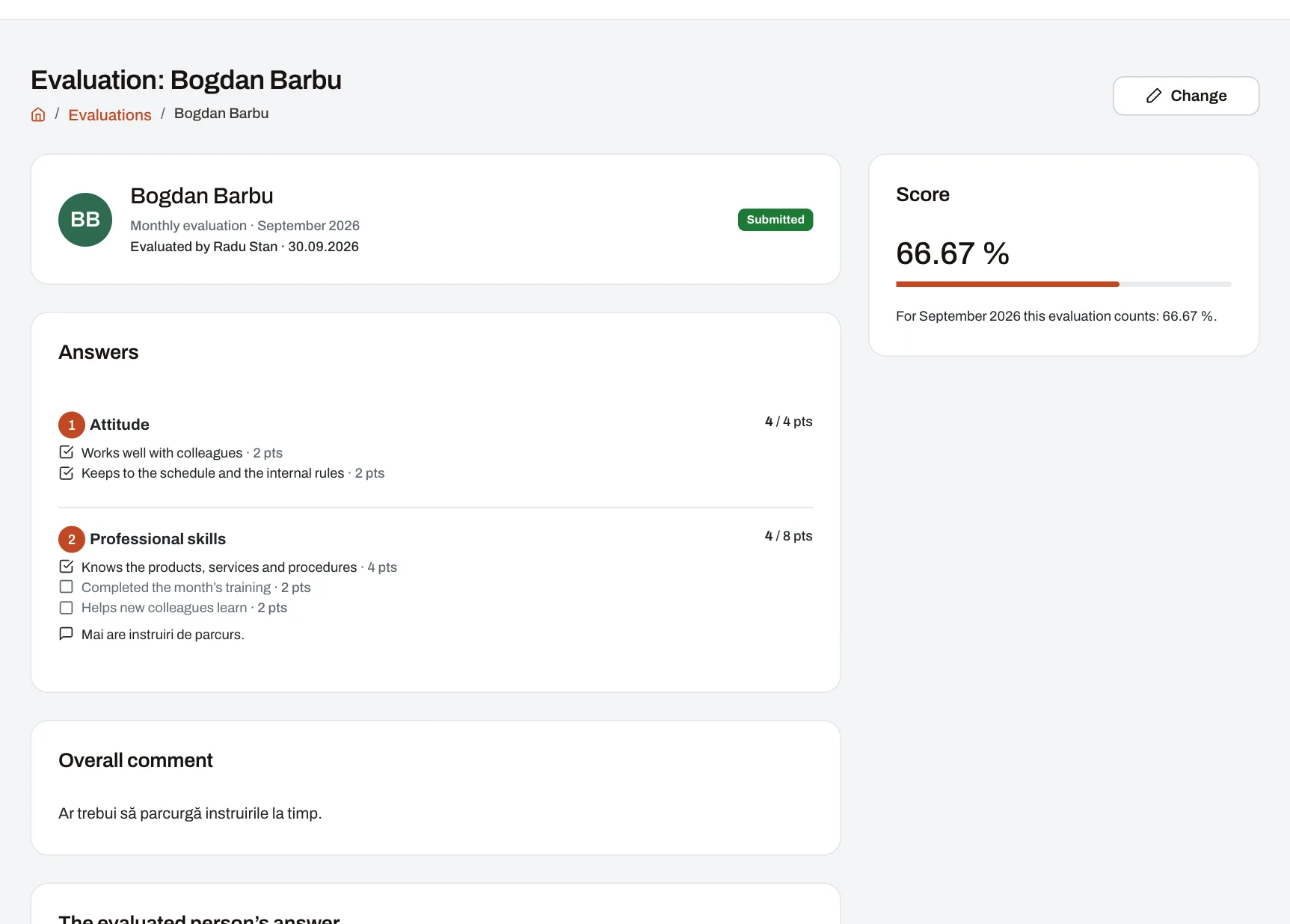
- Behaviours are assessed on the company’s evaluation forms: criteria to tick with points, levels to choose one from, or a rating on a scale, with a comment on each criterion and a general one. The application calculates the points from the form, and the result appears in points or as a percentage of the form’s maximum.
- Figures and weights sit in the scorecards, where each evaluation form becomes an indicator (the average of the period’s evaluations) and enters the score with its weight, next to sales or quality. The levels start from four standard levels, with names and thresholds you can change.
- Fairness: if the form shows them the evaluation, the employee sees it, confirms they have read it and, where the form allows, can reply once; nobody assesses themselves; a missing evaluation shows as “no data”, not 0.
Frequently asked questions
Which criteria go into an appraisal form?
Put in three or four quantitative criteria, tied to the result the role exists for, and two or three behavioural criteria, tied to the way the work is done. Each quantitative criterion has a target, a source and a direction; each behavioural criterion has observable anchors. Choosing the indicators for a role is explained step by step in the dedicated guide to KPI indicators.
Is an appraisal form required by law?
Romania’s Labour Code does not prescribe a particular form, but it requires the evaluation criteria to be communicated to the employee (art. 17(3)(e)) and the internal regulations to contain the evaluation criteria and procedures (art. 242(i)). For a dismissal on grounds of professional unsuitability, a prior evaluation under the written procedure is mandatory (art. 63(2)).
Which scale is better, 1 to 5 or percentages?
The 1-to-5 scale is easy to discuss and suits behavioural criteria. Percentages of target keep more information for quantitative criteria. The template combines them: it calculates the percentage, then turns it into a rating by thresholds. If the form decides money, consider the proportional rating, which avoids big jumps between 94% and 95%.
How often is the appraisal form filled in?
Frequency is a matter of company practice, not law. For roles with monthly results, such as sales, a quarterly form with short monthly conversations is a common balance. A single appraisal a year leaves too much time between the fact and the conversation and gives the last weeks before the appraisal an undeserved advantage.
Who fills in the appraisal form?
The direct manager fills it in, based on data supplied by whoever holds them: sales, accounts, quality. The employee can do a self-assessment before the conversation, useful for comparison, but does not enter the figures that concern them. If the appraisal may have disciplinary or pay consequences, the procedure in the internal regulations sets out exactly who signs.
What do you do if the employee disagrees with the appraisal?
Record the disagreement in the employee’s comment section, then check the disputed figures at the source. A data error is corrected and the rating recalculated. A disagreement about a behavioural rating is discussed on the basis of the evidence. The route for challenging an appraisal should be described in the evaluation procedure in the internal regulations.
Can I use the same form for every role?
You can use the same structure, the same scale and the same grades for the whole company, which makes results comparable in level. The criteria and weights, however, differ from one role to another. A shared behavioural criterion, for example following procedures, can stay on every form, with anchors adapted to each role.
What to do next
Download the appraisal form, adapt the scale and fill it in for a single role using last quarter’s data, before you communicate it. Then:
- check the quantitative criteria with the guide to KPI indicators;
- prepare how you will explain the rating with the guide to scores people trust;
- to see evaluation forms and scorecards on fictitious data, enter the demo company.