

 Română
 English
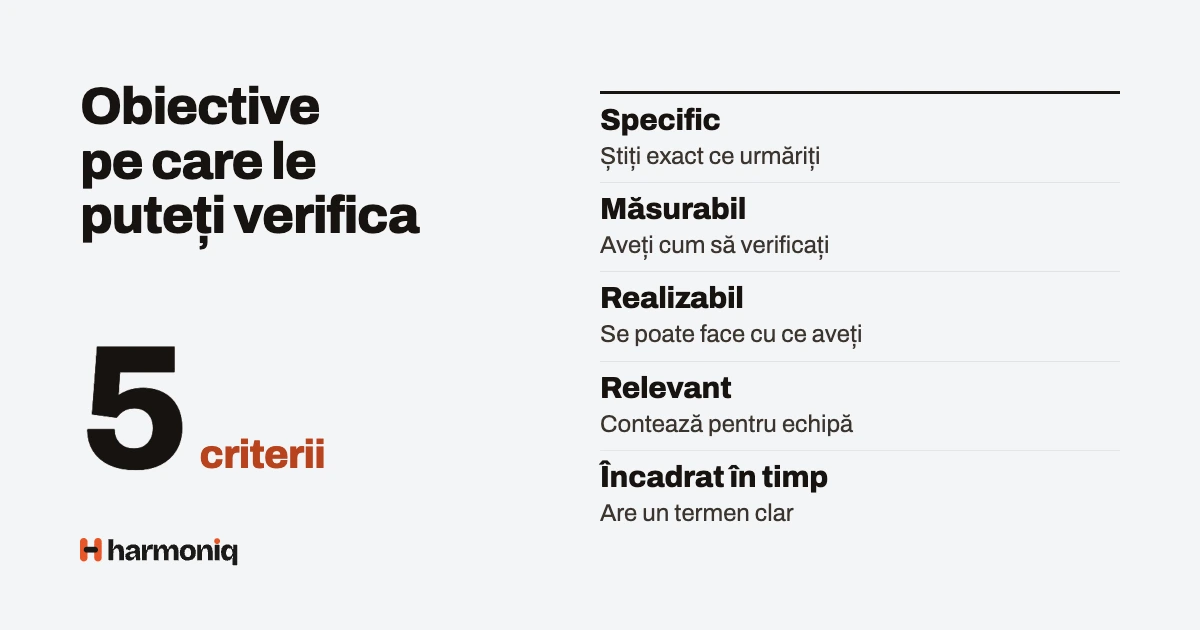
A SMART objective is specific, measurable, achievable, relevant and time-bound: it says which result is reached, how it is measured, from what starting value, by when and why it matters. The method helps with the wording, but it does not tell you whether you have chosen the right objective.
The article rewrites vague objectives as SMART objectives for four roles (HR, sales, operations, customer support), gives you a checklist scored from 0 to 10 and shows, with sources, where the method does not work: on complex tasks and in new roles.
Quick answer. SMART stands for specific, measurable, achievable, relevant and time-bound. A SMART objective names the result, the indicator with its starting value and target, the person responsible and the deadline. Example: “By 31 March 2027, the average time to fill sales assistant positions falls from 45 to 30 days; responsible: the recruitment specialist.”
What SMART means
The SMART method is a set of five criteria for wording objectives. It was proposed by George T. Doran in the November 1981 issue of Management Review, in the article “There’s a S.M.A.R.T. way to write management’s goals and objectives”. In the original version, A stood for “assignable” (assignable to a person) and R for “realistic” (SMART criteria, Wikipedia).
- Specific: the objective names a single result, not an area (“the time to fill positions”, not “recruitment”).
- Measurable: it has an indicator with a definition, a starting value and a target.
- Achievable: the target is ambitious but possible with the resources available.
- Relevant: it links to an objective of the team or the company.
- Time-bound: it has a final deadline and, preferably, interim checkpoints.
The letters vary from one source to another, as the CIPD also notes: A can be “achievable” or “assignable”, R can be “realistic” or “relevant” (CIPD, “Could do better?”, 2016). The difference matters in practice: “assignable” requires a named person responsible, something the modern version often leaves out.
The five letters: the sign one is missing and the fix
| Letter | The check question | The sign it is missing | How to fix it |
|---|---|---|---|
| S — specific | Which result exactly changes? | Verbs such as “improve”, “optimise”, “focus on” | Name the result and whom it concerns |
| M — measurable | Which figure shows the progress? | There is no starting value or data source | Write the indicator, the source, the current value and the target |
| A — achievable / assignable | Can it be reached, and who answers for it? | The target is a “round” number or has no one responsible | Check the history and the resources; name a person |
| R — relevant | Which company objective does it serve? | Nobody can say why it matters | Link it to the objective above it, in the same sentence |
| T — time-bound | By when, and with which checks along the way? | “As soon as possible”, “over the year” | A precise date and one or two interim checks |
Examples rewritten for four roles
Fictitious examples. For each role: the vague wording, the SMART wording and what is left to check once the objective has passed the SMART test.
| Role | Vague wording | SMART wording | What is left to check |
|---|---|---|---|
| HR (recruitment) | “We improve recruitment.” | “By 31 March 2027, the average time to fill sales assistant positions falls from 45 to 30 calendar days, from the approval of the position to the acceptance of the offer. Responsible: the recruitment specialist.” | Speed can lower quality: also track how many of those hired are still there after 90 days. |
| Sales | “We sell more to existing customers.” | “In Q1 2027, net sales from the existing portfolio reach 432,000 lei (+8% on 400,000 lei in Q1 2026), with at least 90% of invoices collected on time.” | Growth can come from discounts: also track the margin. |
| Operations (stock) | “Stock must be managed better.” | “By 30 June 2027, stock accuracy at the monthly sample count rises from 92% to 97% of the items counted, in all six stores. Responsible: the operations manager.” | The result also depends on the stores: the store managers need their own targets. |
| Customer support | “We answer customers faster.” | “From January 2027, 90% of the requests received by email during working hours get a first reply within 4 working hours at most, measured monthly from the ticketing system.” | A quick reply does not mean a solved problem: also track first-contact resolution. |
HR: the definition changes the figure
“Time to fill” can start at the approval of the position, at the publication of the advert or at the first interview, and can end at the acceptance of the offer or on the first day of work. The same recruitment can measure 45 or 28 days, depending on the definition. The SMART objective fixes both ends; otherwise the 30-day target can be reached merely by changing the way of counting.
Sales: the target is checked by calculation
400,000 × 1.08 = 432,000 lei. The target is written both in lei and as a percentage, so that there are not two readings of “+8%”. The collection condition turns the objective from one about invoicing into one about real sales.
Operations: the denominator is written down
Stock accuracy means the items whose book stock matches the physical stock, divided by the items counted. With 200 items counted, 92% means 184 correct items, and 97% means 194. Without a denominator, “97%” can be achieved by counting only the items that are easy to check.
Support: the share of requests, not the average
The average response time hides the very late cases: ten replies within 1 hour and one in 30 hours give an average of (10 × 1 + 30) ÷ 11 = 3.6 hours, below the 4-hour target, even though one customer waited more than a day. The wording “90% of requests within 4 hours at most” makes the long delays visible.
The SMART checklist, with a score
Give each letter 0, 1 or 2 points. An objective ready to be communicated has at least 8 points out of 10 and no 0.
| Letter | 0 points | 1 point | 2 points |
|---|---|---|---|
| S | A vague area | A clear area, an unclear result | One clear result, a single person responsible |
| M | No figure | A figure without a definition or without a starting value | A defined indicator, source, starting value, target |
| A | Nobody knows whether it is possible | Estimated from impressions | Checked against the history and the resources available |
| R | Linked to nothing | Linked to the team’s objective | Explicitly linked to a company objective |
| T | No deadline | A final deadline only | A final deadline and interim checks |
Hypothetical example. “We improve recruitment” scores S 0, M 0, A 0, R 1 (recruitment obviously serves growth), T 0: 1 point out of 10. The SMART version in the table scores S 2, M 2, A 1 (30 days has not been checked against the history), R 1, T 1: 7 points. It does not pass yet: missing are a check against the latest recruitments, the link to the company’s opening plan and a check halfway through the period.
The limits of the SMART method
SMART is a checklist for wording. Research on goal setting shows where it falls short.
- It does not choose the objective. A perfectly worded objective can be the wrong one. The check comes from the chain running from the company’s objective to the task, described in the article on KPIs, objectives, targets and tasks.
- “Achievable” can become “easy”. Edwin Locke and Gary Latham, who summarised 35 years of research, show that specific, difficult goals consistently led to better performance than the exhortation to “do your best”, and that performance rises with difficulty, up to the limit of ability or commitment (Locke and Latham, American Psychologist, 2002).
- Complex tasks call for a different kind of goal. The same study and the 2016 CIPD report show that, on new or complex tasks, outcome goals work less well than learning or behavioural goals until people have mastered the work. For a new coordinator, “test three ways of scheduling shifts and document the result” may be more useful than a cost target.
- “Measurable” draws you to what is easy to count. What can easily be counted is not necessarily what matters. The effects are described in the article on KPIs that encourage the wrong behaviour.
- Not every objective can be quantified. Doran himself noted that it is not always possible to quantify objectives at every level of management. For roles that are hard to measure, read the article on the performance of hard-to-measure roles.
Caution. Locke and Latham also describe an effect of rewards: when the goal is very difficult and the bonus is paid only on reaching it, people who see they will not get it lower their own goals and, with them, their performance. If you tie a SMART objective to a bonus, avoid a single “all or nothing” threshold.
How to rewrite a vague objective in six steps
- Write the desired result in one sentence, without vague verbs. Ask: “What does the situation look like when we have succeeded?”
- Choose the indicator and write its full definition: what is counted, how it is counted and from which source.
- Find the starting value from the last 3–6 months. Without it, the target cannot be judged.
- Set the target starting from the history and the resources, then check it with the person who will carry it.
- Set the deadline and one or two interim checks, with dates in the calendar.
- Add the quality pair: the indicator that would fall if the target were reached through a shortcut. Then give the objective its score from the checklist.
Common mistakes
- The activity instead of the result. “We run 10 training sessions” is a task. Correct it: write what changes after the training.
- A target without a starting value. “Stock accuracy of 97%” does not say whether it is a big jump or holding steady. Correct it: “from 92% to 97%”.
- A percentage without a denominator. “90% resolved” out of what: tickets received, closed, assigned? Correct it: write the denominator into the definition.
- Too many objectives. Ten SMART objectives per person dilute attention. Correct it: three to five, and the rest as tracking indicators.
- The objective is never reviewed. A 12-month deadline without interim checks lets problems be discovered too late. Correct it: a monthly or quarterly check.
- Outcome goals for people still learning the job. Correct it: learning goals in the first months, then outcome goals.
Frequently asked questions
What does SMART mean for objectives?
SMART is an acronym for five criteria for wording objectives: specific, measurable, achievable (or assignable), relevant (or realistic) and time-bound. The method was proposed by George T. Doran in 1981, in Management Review. The letters have varied over time, but the idea has stayed the same: a clear result, with a figure, a person responsible and a deadline.
What is an example of a SMART objective for an employee?
An example for a sales representative: “In Q1 2027, net sales from the existing portfolio reach 432,000 lei, that is +8% on 400,000 lei in Q1 2026, with at least 90% of invoices collected on time.” The objective has a result, an indicator, a starting value, a target, a deadline and a quality condition.
Does every objective have to be SMART?
Not every objective has to be SMART. For clear, repetitive results, such as sales or response times, the method works well. For new or complex tasks, research shows that learning or behavioural goals give better results until people have mastered the work. For roles that are hard to measure, observable outcomes can take the place of a figure.
What is the difference between a SMART objective and a KPI?
The KPI is the measure, for example the average time to fill positions. The SMART objective uses a KPI and adds the starting value, the target, the deadline, the person responsible and the reason. The same KPI can sit in several successive objectives: 45 days down to 30 this year, 30 down to 25 next year.
How ambitious should a SMART objective be?
Difficult enough to demand effort, but not beyond what the person’s abilities and resources allow. Locke and Latham’s summary shows that specific, difficult goals lead to better performance than easy or vague ones, provided people are committed to them and receive feedback on their progress.
Who writes an employee’s SMART objectives?
The direct manager proposes them, starting from the team’s objectives, and the employee discusses them before the period begins. Romania’s Labour Code gives the employer the right to set individual performance objectives (art. 40(1)(f)). Discussing them with the person is not a requirement of the method, but it helps to check that the target is realistic.
What does SMARTER mean?
SMARTER is an extension of the method that adds two letters, most often “evaluated” and “reviewed” (the variants differ from one source to another): the objective is evaluated and reviewed along the way. In practice, this means the interim checks in the checklist above. You can get the same effect without a new acronym, by putting the check dates in the calendar.
What to do next
Take three objectives from the team’s current forms and score them with the checklist. Rewrite those under 8 points with the six steps. Then:
- check that each objective links to a company objective, with the article on KPIs, objectives, targets and tasks;
- if you want to combine ambitious objectives with stable indicators, read the comparison of KPIs and OKRs;
- for development objectives, use the individual development plan.