

 Română
 English
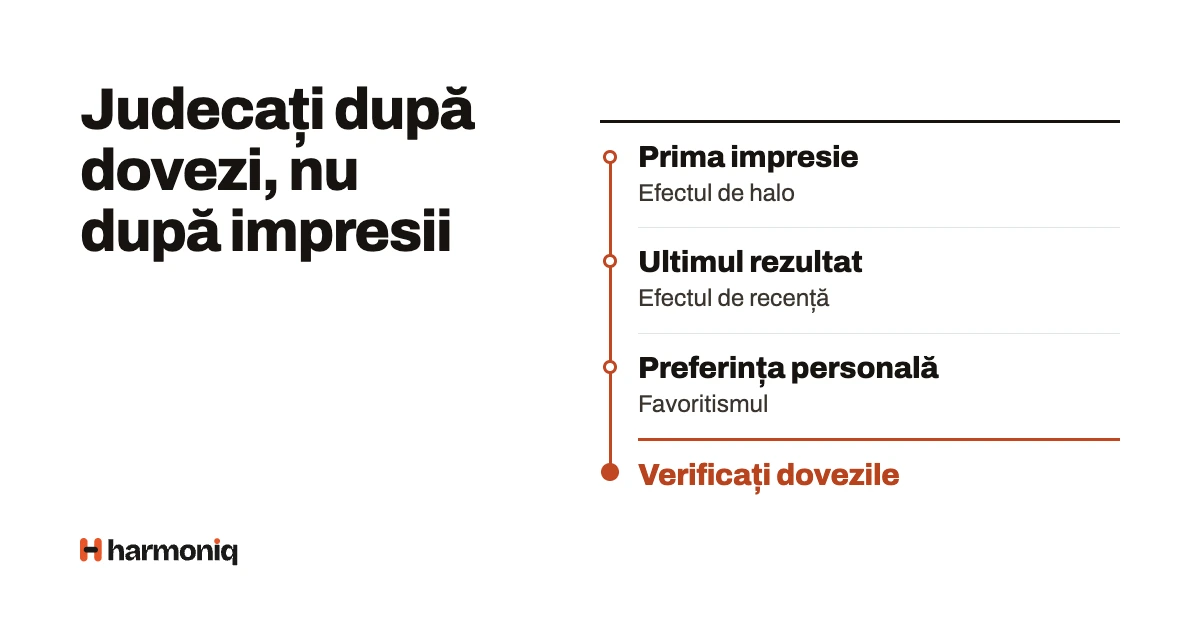
Errors in employee evaluation are, for the most part, the assessor’s errors: the general impression that colours every criterion (the halo effect), the last few weeks covering the rest of the period (recency), ratings that are too lenient or too harsh, ratings bunched in the middle of the scale, comparison with the colleague assessed just before, and favouritism. The article explains each one, shows how to recognise them in ratings already given, with an example calculated for two assessors, and proposes concrete countermeasures: an observation log, behaviourally anchored scales, assessing one criterion at a time and a checklist before submitting.
Quick answer. The main assessor errors are the halo effect, the recency error, leniency or severity, central tendency, the contrast effect and favouritism. They are reduced by observations noted throughout the period, criteria described as behaviours, assessing each criterion in turn for everyone, training assessors on shared examples and comparing ratings between assessors before they are communicated.
What assessor errors are
An assessor error is a systematic deviation of the rating from the real performance, caused by the way the assessor observes, remembers or judges. It is systematic, not random: the same assessor repeats it across several people or several periods.
Assessor errors differ from errors in the system. A form with vague criteria, a scale without descriptions or a wrong target produce poor ratings even with careful assessors. Both kinds matter, but they are corrected differently: the system is corrected through design, the assessor through structure, training and comparison.
The size of the problem is documented. A study published in the Journal of Applied Psychology on two large data sets (2,350 and 2,142 managers, each rated by seven people: two bosses, two peers, two subordinates and themselves) found that the raters’ own tendencies explained 62% and 53% of the variance in ratings, and the performance of the person rated only 21% and 25%.
The ratings were for development, not for pay, so the figures do not transfer automatically to any company. The direction, however, is clear: a rating often says as much about the assessor as about the person assessed.
The errors in brief: what happens and how it shows
| Error | What happens | The sign in the ratings | The main countermeasure |
|---|---|---|---|
| The halo effect | A general impression (good or bad) carries over to every criterion | The same rating on every criterion for the same person | Assess one criterion at a time for everyone |
| Recency | The last few weeks count for more than the rest of the period | Comments only about recent events | An observation log throughout the period |
| Leniency | Ratings systematically too high | The assessor’s average far above the others’; many top ratings | Clear descriptions for the top rating; comparison between assessors |
| Severity | Ratings systematically too low | The assessor’s average far below the others’ | The same descriptions; shared examples of “on track” |
| Central tendency | Ratings bunch in the middle of the scale | Almost every rating is 3 on a 1-to-5 scale | Behaviourally anchored scales; the obligation to justify any rating |
| The contrast effect | The rating depends on who was assessed just before | Ratings that alternate with the order of the assessments | Compare with the written standard, not with the colleague |
| Favouritism and similarity | People close to or similar to the assessor get better ratings | Differences in ratings that follow relationships, not results | Evidence for every rating; a second assessor |
| First impression and confirmation | The assessor looks for evidence for the opinion formed at the start | Ratings stable over time, whatever the results | Concrete examples from the current period |
The halo effect
The halo effect is the carrying over of a general impression to criteria that should be judged separately. The psychologist Edward Thorndike named it in a 1920 article, “A constant error in psychological ratings”. A salesperson who is very good at collections automatically gets high ratings for following procedures too; an introverted colleague gets low ratings for knowledge as well.
The negative version is sometimes called the “horns effect”: a single serious incident pulls every rating down. The countermeasure is structural: assess the “Collaboration” criterion for everyone, then the “Knowledge” criterion for everyone, instead of filling in one person’s form from top to bottom.
The recency error
The recency error is the overweighting of recent events in the judgement of a whole period. In an annual appraisal done in December, the last two months end up weighing more than January to October. Someone who had a weak quarter at the start and a good one at the end comes out better than someone with the reverse path, even though the annual result may be identical.
The countermeasure is a short log: two or three lines a month for each person, with facts and dates. Monthly or quarterly evaluations also reduce the problem, because the period being judged is shorter.
Leniency, severity and central tendency
Leniency means ratings systematically too high, severity ratings systematically too low, and central tendency ratings bunched in the middle. All three compress the real differences between people. The causes differ: avoiding conflict, fear that a low rating will rebound on the manager, very high personal standards or a lack of observations.
These errors are rarely visible in the evaluation of a single person and very clear across an assessor’s ratings as a whole. A manager for whom 80% of ratings are the maximum and one for whom 80% are 3 are not using the same scale, even if the scale is the same on paper.
The contrast effect
The contrast effect is judging a person by comparison with the one assessed immediately before, not against the standard. An ordinary person looks weak after an excellent colleague and good after a weak one. The problem grows when a manager fills in ten evaluations in the same afternoon.
The countermeasure is to have the written description of each level in front of you and to compare each person with it. A different order of people from one criterion to the next also helps.
Favouritism and the similarity error
Favouritism means better ratings for the people close to the assessor, and the similarity error better ratings for those who resemble them: the same age, the same style, the same background. Unlike the other errors, this one can also touch the principle of equal treatment.
Romania’s Labour Code establishes equal treatment and prohibits direct or indirect discrimination against employees on grounds such as age, sex or ethnicity (art. 5). Personal liking is not in itself a protected ground, but a difference in ratings that follows such a ground becomes a legal problem, not just a management one.
Evaluation itself is a right of the employer: it sets the individual performance objectives and the evaluation criteria (art. 40(1)(f)), and the internal regulations must contain the criteria and procedures for professional evaluation (art. 242(i)). If an evaluation may lead to consequences for the employment contract, check the procedure with the company’s lawyer.
First impression and confirmation
The first-impression error is holding on to the judgement formed in the first weeks of work. It is reinforced by confirmation: the assessor notices more easily the facts that support their opinion and overlooks the others. The result is ratings that stay the same year after year, even when the measurable results change.
The check question is simple: “What happened in this period that supports the rating?”. If the examples come from last year, the rating describes a reputation, not a period.
How to recognise the errors in ratings already given
A single evaluation does not reveal a systematic error. An assessor’s ratings as a whole can suggest one. Three simple calculations, which anyone with the ratings in a table can do:
- The assessor’s average rating, compared with the average of the other assessors using the same form.
- The share of top ratings: how many 5s out of all the ratings given.
- The people with the same rating on every criterion: a large number suggests the halo effect.
Hypothetical example. Two store coordinators each assess six people on four criteria (serving customers, product knowledge, collaboration, following procedures), on a scale from 1 to 5. Fictitious data.
| Signal | Coordinator X | Coordinator Y | How it is calculated |
|---|---|---|---|
| The average of all ratings | 4.67 | 3.67 | X: 112 points ÷ 24 ratings; Y: 88 ÷ 24 |
| The share of 5s | 66.7% | 16.7% | X: 16 out of 24; Y: 4 out of 24 |
| People with the same rating on every criterion | 4 out of 6 | 0 out of 6 | Count the rows with four identical ratings |
| The range of averages per person | 4.00–5.00 | 3.00–4.50 | The average of each person’s four ratings |
X’s ratings show the signs of leniency (an average one point higher, two thirds top ratings) and of the halo effect (four people with identical ratings on every criterion). Y’s ratings use the whole scale and tell the criteria apart.
Caution. A signal is not proof. X’s team may genuinely be better. Check the ratings against the same people’s measurable indicators (sales, audits, complaints) and talk to the assessor before drawing conclusions. The comparison becomes systematic in the calibration meeting.
Countermeasures that work
The instruction “be objective” does not change much, because the errors are not intentional. What works is structural change and training on shared examples. Frame-of-reference training has assessors rate the same cases, compare their ratings and discuss the standard; research describes it as an effective intervention for rating accuracy.
- Behaviourally anchored scales. Each rating has an observable description: “5 — resolves complaints alone and records them the same day”, not “5 — excellent”.
- The observation log. Dated facts, noted monthly, for each person.
- Assessing by criterion, not by person. It reduces halo and contrast.
- Justifying extreme ratings. Every 1 or 5 comes with a concrete example from the period.
- A second assessor or a multi-source evaluation, where the role allows.
- Keeping ratings separate from measurable indicators. What can be counted is taken from the data, not from the assessor’s impression.
The steps of an evaluation round with fewer errors
- Review the form a month ahead: each criterion has a description for each rating. You will find a starting template in the appraisal form template.
- Train the assessors for 60–90 minutes on two or three fictitious cases: each rates them alone, then you compare the ratings and discuss the differences.
- Ask for the observation log for the period before the forms are filled in.
- Fill in by criterion: one criterion for everyone, then the next.
- Go through the checklist below before submitting.
- Compare the signals (the average, the share of top ratings, identical ratings) between assessors and discuss the large differences.
- Only then communicate the evaluations to people.
The assessor’s checklist
- Do I have at least one example from this period for every rating of 1 or 5?
- Do my examples cover the whole period or only the last few weeks?
- Have I given someone the same rating on every criterion? If so, can I justify it separately for each criterion?
- How many top ratings have I given, compared with what my colleagues usually give?
- Would I give the same rating if the person had been assessed first, not after the best person on the team?
- Does the rating rest on results and behaviours, not on how well I get on with the person?
Common mistakes in correcting the errors
- Forced distribution as a cure-all. Imposing a fixed percentage on each level hides leniency, but it can penalise a good team. Correct it: compare and discuss, do not split automatically.
- Correcting ratings without the assessor. Ratings quietly adjusted by HR destroy trust. Correct it: the assessor reviews their own ratings after the discussion.
- A form with vague criteria. On “good attitude”, every assessor has a halo. Correct it: observable descriptions for each rating.
- An annual appraisal with no notes along the way. Correct it: a monthly log or short, regular conversations.
- Confusing evaluation with discipline. A low rating is not a sanction. For weak results, read the appraisal conversation when results are weak.
- The signal taken as proof. Correct it: check with measurable data and with the assessor before drawing conclusions.
Frequently asked questions
What is the most common error in employee evaluation?
There is no ranking that holds for every company: frequency depends on the form, the assessors and what the rating decides. When the rating decides money or promotions, leniency has an obvious motive, and on vague criteria the halo effect appears easily. Find out what happens in your company by comparing each assessor’s average, share of top ratings and identical ratings.
What is the halo effect in performance appraisal?
The halo effect means that a general impression of a person influences the ratings on every criterion, although they should be judged separately. Someone good at sales gets high ratings for procedures too, without evidence. The typical sign is the same rating on every criterion. The simplest countermeasure is assessing one criterion at a time for everyone.
How do I avoid the recency error in the annual appraisal?
Keep a short observation log throughout the period, with two or three dated facts a month for each person. At appraisal time, reread it before giving the ratings. More frequent evaluations, monthly or quarterly, also reduce recency, because the period judged is shorter and the assessor’s memory covers the events better.
Does forced distribution help against leniency?
Forced distribution removes leniency from the figures, but it does not correct it in the judgement: it forces the assessor to put people on low levels even when the team is good. It can also create unwanted competition between colleagues. A better alternative is comparing ratings between assessors and discussing the differences in a calibration meeting, on the basis of evidence.
What is frame-of-reference training?
Frame-of-reference training is a session in which assessors rate the same cases, compare their ratings and discuss what each level of the scale means. The aim is for everyone to use the same standard. Research in organisational psychology describes it as an effective intervention for rating accuracy. Choose cases that resemble the team’s real work, so that the discussion stays concrete.
Do the errors disappear if we use only measurable indicators?
Assessor errors decrease, but other problems appear: indicators miss important behaviours, and people may optimise the figure instead of the work. Most roles need both: indicators for what can be counted and a structured evaluation for the rest. The combination also reduces dependence on one person’s impression.
What do I do if I suspect a manager of favouritism?
Start with the data: compare the manager’s ratings with the same people’s measurable indicators and with other assessors’ ratings. Discuss the differences with the manager, asking for concrete examples for the disputed ratings. If the suspicion concerns grounds protected by law, such as age or sex, involve the company’s lawyer before taking any action.
What to do next
Take the ratings from the last evaluation round, calculate the three signals from the example for each assessor and choose a single criterion for which you write a description for each rating. For the next step, hold a calibration meeting and review how you explain a score to the people assessed.