

 Română
 English
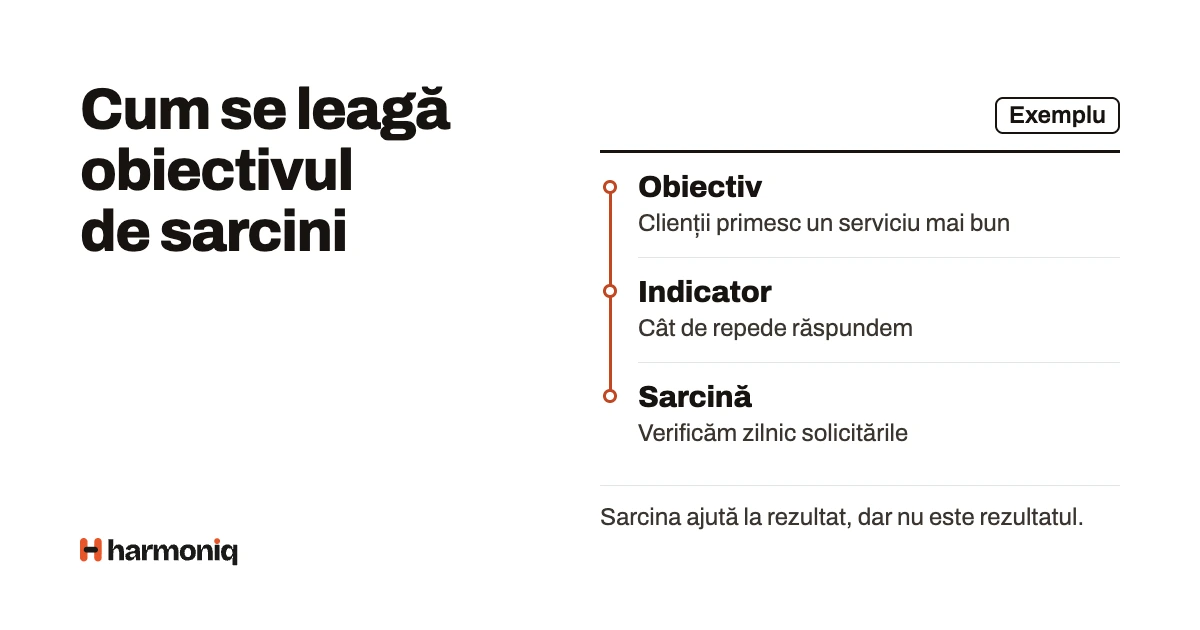
The objective says what the company wants to achieve, the KPI shows how close it is, the target fixes the value that means “achieved” in a given period, and the task is the day-to-day work that moves the indicator. The four link into a chain: from the company’s objective, through the unit’s and the person’s objectives, down to the tasks on a shift.
The article gives a fully calculated chain for a store, the same chain in four sectors, the distinction Romania’s Labour Code draws between the duties in a job description and performance objectives, and five questions to check whether the chain in your company holds together.
Quick answer. The objective is the desired result, put into words. The KPI is the figure that shows progress towards the objective. The target is the value the KPI must reach in a given period. The task is a concrete activity, carried out by one person, that influences the KPI. A system works when every important task links to a KPI, and every KPI to an objective.
Definitions: objective, KPI, target, task
The objective is the result the company, a unit or a person wants to achieve, put into words. “Customers come back to our stores more often than last year” is an objective. An objective does not have a figure yet; it gives the direction and the reason.
The key performance indicator (KPI) is a measure with a definition, a unit of measure, a source and a frequency, chosen because it shows progress towards an objective. “Like-for-like sales against the same month last year, as a percentage” is a KPI. Every KPI is a metric, but not every metric is a KPI: it becomes “key” only if it serves a specific objective.
The target is the value the KPI must reach in a precise period: “+5% in 2027”. The target can change from one period to the next, while the indicator stays the same. The threshold (below which nothing is awarded) and the cap (above which the result no longer rises) are rules added to the target, not separate targets.
The task is a concrete activity, with someone responsible and a moment: “check the shelves of seasonal products at opening”. Tasks are ticked off, not measured on a scale. Between the objective and the tasks there are sometimes initiatives: time-limited projects, such as “we reorganise the seasonal aisle by 1 November”.
What sets them apart, in a single table
| Element | Which question it answers | Form | Example (store) | Who sets it | How often it changes |
|---|---|---|---|---|---|
| Objective | What do we want to achieve, and why? | A sentence | Customers buy more on each visit | Senior management, then managers level by level | Yearly or when the strategy changes |
| KPI | How do we know we are getting closer? | A figure with a definition and a source | Average transaction value, in lei, from the till system | The manager, with whoever holds the data | Rarely; a change breaks the comparison over time |
| Target | What does “achieved” mean this period? | Value + period | 105 lei in November | The manager, with the agreement of the level above | Every planning period |
| Initiative | What do we change to reach the target? | A project with a deadline | A new shelf of complementary products next to the till | The unit manager | When it ends or does not deliver |
| Task | What does someone do today? | An action that can be ticked off | Recommend a complementary product to every customer served | The direct manager or the person themselves | Daily or weekly |
Remember. If an element can be ticked off, it is a task. If it can be counted over time and has a data source, it can be a KPI. If it has a value and a period, it is a target. If it has no figure at all but says why you are working, it is an objective.
How the chain runs from the company to the daily task
The chain has five links. Each link answers “how?” for the link above it and “why?” for the one below. If the question “why are we doing this?” has no answer for a task, the task serves no objective or the chain has a missing link.
- The company’s objective, with its KPI and its target for the coming year.
- The unit’s or department’s objective: the part of the company’s objective that the unit can influence.
- The individual objective: the part the person can influence, in their role.
- The individual KPIs and targets: 3–5 figures that show the person’s progress.
- The initiatives and tasks: what is actually done, weekly and daily.
A worked example: one store in a chain
Hypothetical example. Fictitious data, rounded so it can be redone by hand.
A chain of stores has the objective “we grow like-for-like sales without the margin falling”. The company’s KPI is like-for-like sales against last year, and the target for 2027 is +5%. Store A sold an average of 400,000 lei a month; its target becomes 400,000 × 1.05 = 420,000 lei a month.
A store’s sales break down into three factors: visitors × conversion rate × average transaction value. For store A: 20,000 visitors × 20% × 100 lei = 400,000 lei. The breakdown shows which route can lead to 420,000 lei.
| Option | Visitors | Conversion | Average transaction | Sales per month |
|---|---|---|---|---|
| The current situation | 20,000 | 20% | 100 lei | 400,000 lei |
| Higher conversion only | 20,000 | 21% | 100 lei | 420,000 lei |
| Higher average transaction only | 20,000 | 20% | 105 lei | 420,000 lei |
The store manager chooses the route the team can influence. Footfall depends mainly on the location and on central campaigns, so it does not become an individual target. The average transaction depends on the sales assistants’ recommendations, so it becomes the individual objective: “the customers I serve leave with everything they need”.
For a sales assistant, the KPI is the average value of the transactions they ring up, with a target of 105 lei in November. Next to it sits a quality indicator, the return rate, so that recommendations do not turn into pushy selling. The tasks that move the average transaction are concrete: recommending a complementary product to every customer, knowing the week’s promotion, restocking the shelf next to the till at the start of the shift.
Caution. Individual targets are not obtained by dividing the store’s target by the number of people. A part-time sales assistant, or one in their second month in the job, cannot carry the same share. Splitting equally breaks the link between the target and what the person can influence.
The same chain in four sectors
Fictitious examples. The table shows that the structure stays the same, even if the figures differ from one sector to another. The last column holds tasks, not indicators: they are ticked off or checked by observation.
| Sector | The company’s objective | The individual objective | KPI and individual target | Typical tasks |
|---|---|---|---|---|
| Retail | Like-for-like sales +5%, without the margin falling | The customers served buy everything they need | Average transaction 105 lei; returns under 2% | A complementary recommendation for every customer; the shelf next to the till restocked |
| Hotel | Average reviews of at least 9 out of 10 | Arrivals without waiting and without errors | Check-in under 5 minutes for 90% of arrivals; billing errors: at most 2 a month | Rooms checked before the arrival time; guests pre-registered the day before |
| Pharmacy | Patients who come back, correct service | Full counselling when dispensing | A score of at least 90% at the internal check visit | Explaining how to take the medicine; checking the interactions flagged by the software |
| Real estate | More transactions from the exclusive portfolio | A larger exclusive portfolio | 3 new exclusive agreements per quarter | Property valuations scheduled weekly; following up the owners contacted |
The pharmacy target is deliberately one of quality, not sales. In sectors where a volume incentive can conflict with the customer’s interest, the first KPI chosen says the most about what the company values.
Duties and objectives in the Labour Code
Romania’s Labour Code (Law 53/2003, consolidated version on the Legislative Portal, checked on 18 October 2026) separates two things that practice often mixes up:
- Duties: the employee has the obligation “to achieve the work norm or, as the case may be, to fulfil the duties assigned to them under the job description” (art. 39(2)(a)). Daily tasks usually follow from these duties.
- Performance objectives: the employer has the right “to set the individual performance objectives, as well as the criteria for assessing their achievement” (art. 40(1)(f)).
- Evaluation criteria are communicated: the employee is informed of “the criteria for evaluating the employee’s professional activity applicable at the employer” (art. 17(3)(e)), and the internal regulations contain “the criteria and procedures for the professional evaluation of employees” (art. 242(i)).
The law defines neither the KPI nor the target; how you choose them is a management matter. A practical rule for management still follows: the tasks in the job description are required, while objectives and evaluation criteria are set in advance and communicated. When a KPI affects pay or may support a dismissal for professional unsuitability (art. 61(d) and art. 63(2)), check the documents with the company’s lawyer.
How to build the chain for a role
- Write down the company’s objective with its KPI and its target. If there is no target at company level, the chain has nowhere to start; ask senior management for one.
- Go down to the unit: which part of the result can the unit influence? Break the result down into factors, as in the store example, and keep the factors the unit controls.
- Go down to the role: for each factor kept, ask who moves it. The factor becomes the individual objective of that role.
- Choose the KPI and the target for each individual objective, with a quality indicator beside it. Choosing the indicators themselves is explained in the guide to KPI indicators.
- List the tasks that move each KPI and check that they appear in the job description or in the work instructions.
- Check the sum: added together, the units’ targets must cover the company’s target. If the sum comes out lower, a source of growth is missing; if it comes out much higher, some targets are unrealistic.
Five questions that check the chain
Ask them for each role, once a year and whenever the strategy changes. An “I don’t know” shows the missing link.
- Why? For each important task: which KPI does it move? A task with no answer is either administrative (necessary, but without a target of its own) or pointless.
- How? For each KPI: which tasks move it? A KPI without associated tasks is a figure the person looks at without being able to change it.
- Who? Each KPI has a single person responsible at its level. “The team” is an answer only for team KPIs.
- When? The target has a period, and the data arrive in time for it. A monthly target calculated from quarterly data cannot be followed.
- What would suffer? If the person reached the target by the easiest shortcut, what would suffer? The answer points to the missing quality indicator.
Practical tip. Draw the chain on a single page: objectives at the top, tasks at the bottom, lines between them. The tasks with no line leaving them and the KPIs no line reaches are the first to discuss with the team.
Common mistakes
- The task turned into a KPI. “40 calls a day” measures effort, not results. Correct it: keep the activity as a tracking indicator, and put the target on the result. The difference is explained in the article on activity and result indicators.
- The target without an indicator. “+10%” without saying of what, against what and from which source causes arguments at every month-end close. Correct it: write the indicator’s definition first, then the target.
- The objective confused with the target. “Our objective is 420,000 lei” leaves people without a reason and without a route. Correct it: the objective says what and why, the target says how much.
- A target split equally. The company’s target divided by the number of units ignores the differences between them. Correct it: start from the history and the potential, as in the article on targets for different locations.
- A chain without a quality indicator. Every volume target has a shortcut. Correct it: add the indicator that would fall if the volume were achieved badly; examples in the article on KPIs that encourage the wrong behaviour.
- New objectives, old tasks. The strategy changes, but the job description and the instructions stay the same. Correct it: with every new objective, check which tasks are added and which tasks no longer make sense.
Frequently asked questions
What is the difference between a KPI and an objective?
The objective describes in words the desired result and the reason for it, while the KPI is the figure that shows how close you are to that result. An objective can have one or more KPIs, and a KPI without an objective remains just a metric being tracked. When people know only the KPI, they optimise the figure; when they also know the objective, they can judge unforeseen situations for themselves.
What is the difference between a KPI and a target?
The KPI is the measure, with its definition, source and unit; the target is the value the measure must reach in a given period. “Average transaction value” is a KPI, and “105 lei in November” is a target. The indicator stays stable for years, whereas the target changes every planning period, depending on the history and on the company’s objectives.
Can a task be a KPI?
A task can become an activity indicator when you count it: visits made, calls, checks carried out. As a person’s main indicator, however, a counted task encourages visible effort instead of results. Use it for tracking and for discussion, and put the heavily weighted target on the result, with a quality indicator beside it as protection against shortcuts.
How many levels should the chain have?
As many as the real decision levels you have. A company with a single site usually has three: the company, the person and the tasks. A network with several locations adds the unit and, sometimes, the area. Every extra level needs a target and someone responsible, so do not create levels just because they appear on the organisation chart.
What do you do with tasks that link to no KPI?
You split them into two groups. Administrative or legal tasks, such as mandatory training or the records required at an inspection, stay in the job description without a performance target. Tasks that serve neither an objective nor an obligation are worth discussing with the team, because they take up time without contributing to what the company is pursuing.
Who sets the individual objectives?
The employer, through the direct manager: the Labour Code gives it the right to set individual performance objectives and the evaluation criteria (art. 40(1)(f)). As management practice, discussing them with the person makes the targets more realistic and strengthens commitment to them. The evaluation criteria must be communicated, and the internal regulations must contain them.
How often do objectives and targets change?
The company’s objectives change rarely, usually yearly or with a change of strategy. Targets are revised every planning period: monthly, quarterly or yearly. KPIs should stay as stable as possible, because any change of definition breaks the comparison with past periods and calls for an explanation on every chart.
What to do next
Choose a single role, preferably one with many people in it, and draw its chain on a page, with the five questions above. Then:
- choose the indicators and weights with the guide to KPI indicators;
- word the individual objectives with the SMART method, through examples;
- if you already work with OKRs, read the comparison of KPIs and OKRs.