

 Română
 English
This guide is for HR, unit managers and those who work with an external occupational health and safety (SSM) service. Training usually gets done; the problem comes at an inspection, when it has to be proven. By the end you will have a “who, what training, when, with what proof” matrix, a flow for tracking deadlines and a checklist for inspection day.
This guide does not replace the SSM service or the occupational medicine doctor. The content of the training, its length and its schedule are set by the employer and the competent specialists, based on the risk assessment.
Four things that are not the same thing
| What it is | Why it exists | What it proves |
|---|---|---|
| Internal training (procedures, products, systems) | The company’s decision | That the person went through the material; the company chooses the form of proof |
| A course with a test | The company’s decision, sometimes as part of mandatory training | That the person answered the questions correctly on a given date |
| SSM training | A legal obligation (Law no. 319/2006 and the rules approved by Government Decision (HG) no. 1425/2006) | It is recorded in the individual training sheet (fișa individuală de instruire), with signatures |
| The occupational medicine check-up | A legal obligation (HG no. 355/2007) | The fitness-for-work certificate (fișa de aptitudine) issued by the occupational medicine doctor |
A course with a test can support SSM training, but it does not take the place of the individual training sheet. And a record of the medical check-up is not the fitness-for-work certificate.
What the law says about SSM training and medical check-ups
Sources verified on 18 October 2026, on the Legislative Portal: Law no. 319/2006, the Methodological Rules approved by HG no. 1425/2006 (consolidated version after HG no. 259/2022), HG no. 355/2007.
- Three stages of SSM training: introductory-general, at the workplace and periodic (Rules, art. 77). Each lasts at least one hour, and the length is set in the training and testing programme (art. 80^1).
- Introductory-general training takes place on hiring and ends with a knowledge check based on tests; nobody can be hired without having taken in its content (art. 89).
- Workplace training is given by the head of the workplace, with practical demonstrations; the person starts work only after their knowledge has been checked by the line manager of whoever trained them (art. 90–94).
- Periodic training takes place at the interval set in the training and testing programme, but at most every 6 months; for technical and administrative staff, at most every 12 months (art. 96).
- Additional training is needed, for example, after an absence of more than 30 working days, when procedures or equipment change and when work resumes after a workplace accident (art. 98).
- The individual training sheet must be filled in, on paper or electronically, immediately after the training has been checked, and is signed by the worker and by those who gave and checked the training (art. 81(1)–(3)). The signature can be handwritten or electronic (simple, advanced or qualified), as the employer sets out in the internal regulations; for electronic training, the employer ensures the traceability and integrity of the materials (art. 81(3^1)–(3^3), art. 81^1).
- Keeping the sheet: with the head of the workplace, together with a copy of the latest fitness-for-work certificate, for the whole duration of the employment relationship (art. 81(4)–(5)).
- The periodic medical check-up is mandatory for all workers; its frequency follows the risk-factor sheets in annex 1 and, as a rule, no more than 12 months pass between two periodic check-ups (HG no. 355/2007, art. 20–21 and annex 1). The employer keeps the fitness-for-work certificates, not the medical file, which stays with the occupational medicine service (art. 37–38).
- Electronically signed documents: the Labour Code provides that labour inspectors accept employment and SSM documents signed electronically, without asking for paper copies (Law no. 53/2003, art. 16(1^8)), under the conditions set in the internal regulations or the collective agreement (art. 16(1^2)).
The training matrix: an example
A fictional example, for a logistics company. The intervals below are the maximums set by law or chosen by the company; your training and testing programme may set shorter intervals.
| Role | Training | Trigger | Interval | Responsible | Proof | Deadline |
|---|---|---|---|---|---|---|
| All new employees | SSM introductory-general | Hiring | Once | The SSM service | The signed individual sheet, the test result | Before starting work |
| Warehouse operator | SSM at the workplace | After introductory-general; change of workplace | At each workplace | The shift supervisor | The individual sheet, signed, including by whoever checked | Before starting work |
| Warehouse operator | SSM periodic | Calendar | At most 6 months | The shift supervisor | The signed individual sheet | As per the programme |
| Administrative staff | SSM periodic | Calendar | At most 12 months | The head of department | The signed individual sheet | As per the programme |
| Anyone | SSM additional | Absence of more than 30 working days, accident, new equipment | When it happens | The head of the workplace | The signed individual sheet | Before returning to work |
| Everyone | Periodic medical check-up | Calendar | At most 12 months (or as the risk sheet provides) | HR requests; the occupational medicine doctor decides | The fitness-for-work certificate | Before it expires |
| Warehouse operator | Internal stock count procedure (course with a test) | Hiring; new procedure | Yearly, internal decision | The stock manager | The test result, the certificate | In the first month |
The flow: assign, complete, check, track
- Assign by criteria, not by name. “All warehouse operators” also reaches the operator hired next month; a list of names has to be updated by hand.
- Set the deadline from the start and announce it together with the assignment.
- Check understanding with a short test or a practical demonstration, not just by going through the material.
- Record the proof that fits the type: the individual sheet for SSM, the fitness-for-work certificate for the medical check-up, the test result for internal courses.
- Track expiries at least 30 days ahead, so there is time to schedule.
- Deal with overdue items with each unit’s manager, before an inspector finds them.
An example training file
A fictional example. Mihai Stan, warehouse operator, hired on 2 March 2026:
| Date | What | Proof | Valid until |
|---|---|---|---|
| 24 February 2026 | Medical check-up on hiring: fit | Copy of the fitness-for-work certificate | 24 February 2027 |
| 2 March 2026 | SSM introductory-general, 2 hours, test passed | The individual sheet, signed by the worker, the trainer and whoever checked | — |
| 2 March 2026 | SSM at the workplace, 2 hours, with a demonstration on the pallet truck | The same individual sheet | — |
| 13 March 2026 | Internal course “Stock count procedure”, test 90% | The test result and the certificate | 13 March 2027 (internal decision) |
| 2 September 2026 | SSM periodic, 1 hour | The individual sheet | 2 March 2027 |
Checklist for inspection day
- The list of active employees, by unit and position.
- For each one: the SSM individual training sheet, complete and signed (on paper or electronically, as per the internal regulations).
- The approved and dated training and testing programme, with its topics.
- Copies of the valid fitness-for-work certificates; the list of those whose medical check-up has expired or is scheduled.
- The list of overdue periodic training and the date it is scheduled for.
- For electronic training: the materials used, in the version from the date of the training.
- The internal regulations, with the provisions on electronic signatures, if you use them.
- The person who knows the files and can answer questions.
What a record proves and what has to be checked separately
A record in an app shows that, on a given date, someone recorded a training session or a check-up. On its own it does not prove that the training had the required content and length, that it was given by the right person or that the legal sheet exists and is signed. The employer checks these, together with the SSM service and the occupational medicine doctor. No app guarantees the outcome of an inspection.
Common mistakes
- An online course certificate presented as the SSM sheet. Fix: the individual sheet is filled in and signed separately.
- The interval forgotten for new staff. Fix: assignment by criteria, with a deadline.
- Additional training left out after a long absence. Fix: tie it to the return from leave.
- Medical data kept by the employer. Fix: keep the fitness-for-work certificate, not diagnoses.
- Everything with a single person. Fix: unit managers see their people’s overdue items.
How to apply the steps in Harmoniq
Two separate modules, on the Professional and Enterprise plans:
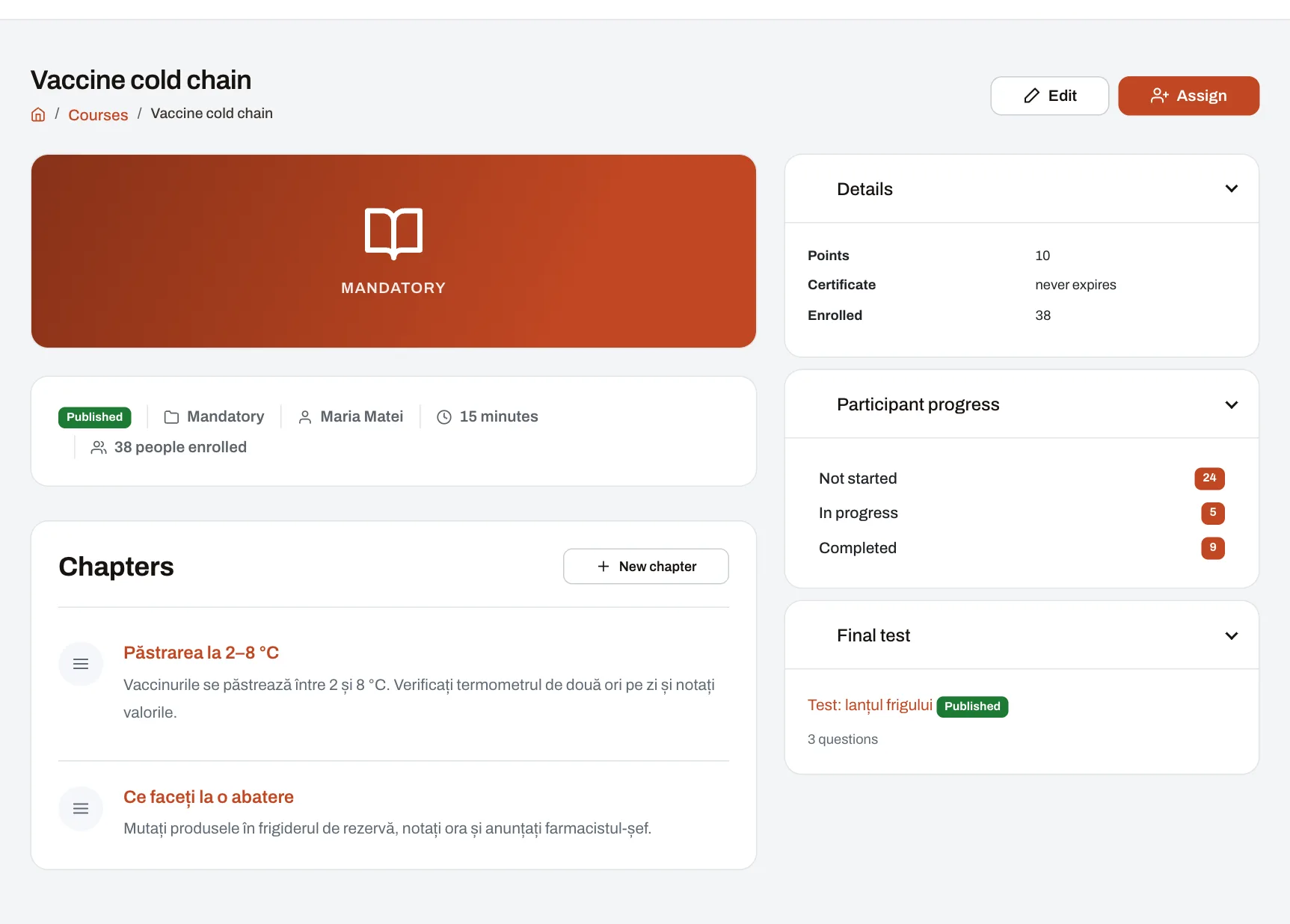
- Training and tests: courses in chapters (text, video, files), tests with a pass mark (70% by default) and a number of attempts, PDF certificates with a number and a verification code that anyone can check online, without an account. Courses are assigned by position, unit, department, area or the whole company, with a deadline; if you tick “Also enroll people who join later”, new colleagues get the course automatically. A course with a validity period and Automatic recertification is reassigned 30 days before the certificate expires.
- Health and safety: the types of training and check-up (introductory-general, at the workplace, periodic every 6 months, fire safety (PSI), medical check-up every 12 months — all of them can be changed), with the date, who gave the training, notes and the signed document attached (the scanned sheet). The status of each: valid, expiring soon, expired or missing. 30 days before expiry, the employee and the SSM leads receive a notification.
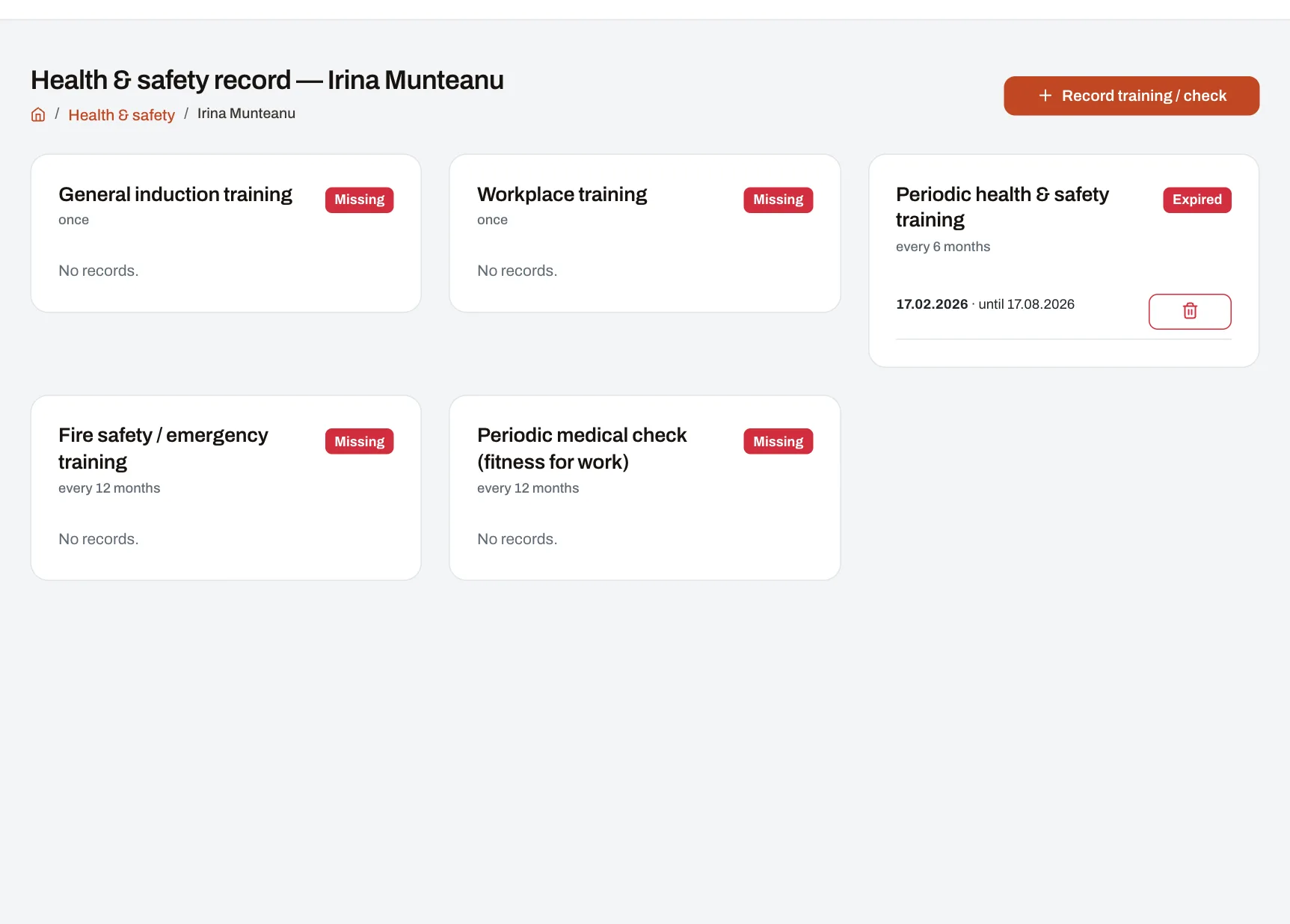
- What the app does not do: it does not generate the individual training sheet, does not sign it electronically and does not keep the result of the medical check-up (only its dates). The SSM records are not linked automatically to courses: a passed course does not create an SSM record.
- For managers: the signals show the overdue training and the expired SSM records of the people in their area.
- For the inspection: an assignment’s list exports to Excel (status, progress, score, attempts, deadline), and the reports have data sets for courses, certificates and SSM.
Frequently asked questions
Can I keep the individual training sheet electronically only?
The Rules allow the electronic format and electronic signatures, under the conditions set by the employer in the internal regulations (HG no. 1425/2006, art. 81). Check with the SSM service and your lawyer how to apply them in your company.
Does a passed test mean the SSM training is in order?
Not on its own. The test is one part of the check; the individual sheet, the content, the length and the signatures are required separately.
How long do I keep the training sheets?
The Rules provide for keeping them for the whole duration of the employment relationship (art. 81(5)). For the period after the contract ends, set the rule with your lawyer, taking archiving and data protection into account.
What medical data does the employer keep?
The fitness-for-work certificate, with the doctor’s conclusion (fit, fit with conditions, temporarily unfit, unfit). The medical file stays with the occupational medicine service (HG no. 355/2007, art. 37–38).
Next step
Fill in the matrix for the roles in your company, together with the SSM service, and check for a single unit whether the files pass the checklist. To see the courses, tests and SSM records, go to the demo company.