

 Română
 English
This guide is for managers, HR and business owners who want thanks between colleagues to become a habit without turning into a popularity contest. By the end you will have a short model for recognition, examples for different roles and a four-week plan for introducing it to your team.
Recognition works when it is specific (it says what the person did), close to the event (the same day or week) and tied to observable behaviour, not to a trait (“you’re great”). A certificate at the end of the year rarely ticks all three.
The model for recognition: four elements
- Context: when and in what situation.
- Behaviour: what the person did, concretely, what someone else would have seen too.
- Effect: what happened because of it.
- Value: which of the company’s values shows in that action.
A model to copy: “[Context], you [behaviour]. Thanks to you, [effect]. That is what [value] means to us.” Two or three sentences are enough.
Examples for different roles
Fictional examples. None contains customer data or sensitive information — a good rule for any public recognition.
| Role | Recognition | Value |
|---|---|---|
| Warehouse worker | “On Thursday, during the stock count, you noticed that two pallets had their labels swapped and stopped the loading until they were corrected. The order went out correctly, with no return.” | Customer care |
| Call centre operator | “This week you wrote a list for the new colleagues of the five questions we get most often about invoicing. Their first calls were shorter.” | Collaboration |
| Night receptionist | “Last night, when the booking system went down, you kept track of the arrivals on paper and entered them in the morning, before the shift change. No room was given out twice.” | Initiative |
| Accountant | “You noticed that a supplier invoice appeared twice in the monthly report and said so before the month was closed. We avoided paying it twice.” | Integrity |
| Store coordinator | “In the week with two colleagues on leave, you redid the schedule so that the till always had two people at peak time, with no overtime for anyone.” | Collaboration |
| Developer | “You documented step by step how to restart the invoicing service. On Friday evening, the colleague on call restarted it in ten minutes, without phoning you.” | Collaboration |
Compare this with “Thank you, you’re so reliable!”: kind, but it tells no one what is worth repeating.
A four-week introduction plan
| Week | What you do | Who |
|---|---|---|
| 1 | Choose 3–5 values and write one sentence for each about what it looks like in practice. Vague values (“excellence”) produce vague recognition. | Management, with a few colleagues from different teams |
| 2 | Managers give the first kudos, following the four-element model, one or two each. These become the example the others copy. | Managers |
| 3 | Explain the why and the how to the teams at the briefing: anyone can recognise anyone, specifically and for something recent. No quotas and no obligations. | Unit managers |
| 4 | Look at who receives kudos and who does not, by shift and by role. If a group is missing, ask why rather than asking for more kudos. | HR |
Fairness: shifts, roles, less visible people
- The night shift and the people behind the scenes (warehouse, accounting, IT) are seen by fewer colleagues, so they receive less recognition. Managers can balance this by deliberately looking at work that goes unseen.
- Customer-facing roles receive more recognition because they have more witnesses. That does not mean they work better.
- Not everyone wants public praise. For some, a thank-you said in private is worth more than one seen by the whole company. Ask them.
Risks to avoid
- The popularity contest. A ranking of “who received the most kudos” rewards people with many friends, not the action. Do not publish it.
- Making it mandatory. “Everyone gives three kudos a month” produces generic recognition, given to tick a box. A thank-you that was asked for is no longer a thank-you.
- Tying it automatically to money. If the number of kudos influences the bonus, kudos get traded (“I’ll give you one, you give me one”). Material rewards are decided separately, on criteria set in advance.
- Recognition as a substitute. Public recognition does not replace a fair salary, a reasonable schedule or fixing a problem someone has raised.
What to measure and what not to
The number of kudos per team, the number of colleagues who give kudos or the split by value are indicative signals of how much the habit is used. They do not prove that a team has a particular culture, nor that productivity has risen. A team with few kudos may be one where people thank each other directly, face to face.
If you use kudos in an indicator, use them at team level, with a small weight, and never as an individual indicator.
Common mistakes
- Generic recognition. Fix: ask for the context and the behaviour; give good examples.
- Only managers give recognition. Fix: the most credible thanks often come from the colleague next to you.
- Too many values. Nobody remembers ten values. Fix: 3–5, with one sentence each.
- Customer details in the recognition. Fix: describe the action, not the person served.
- Individual rankings. Fix: measure by team.
How to apply the steps in Harmoniq
Kudos are part of the company’s social network, on every plan:
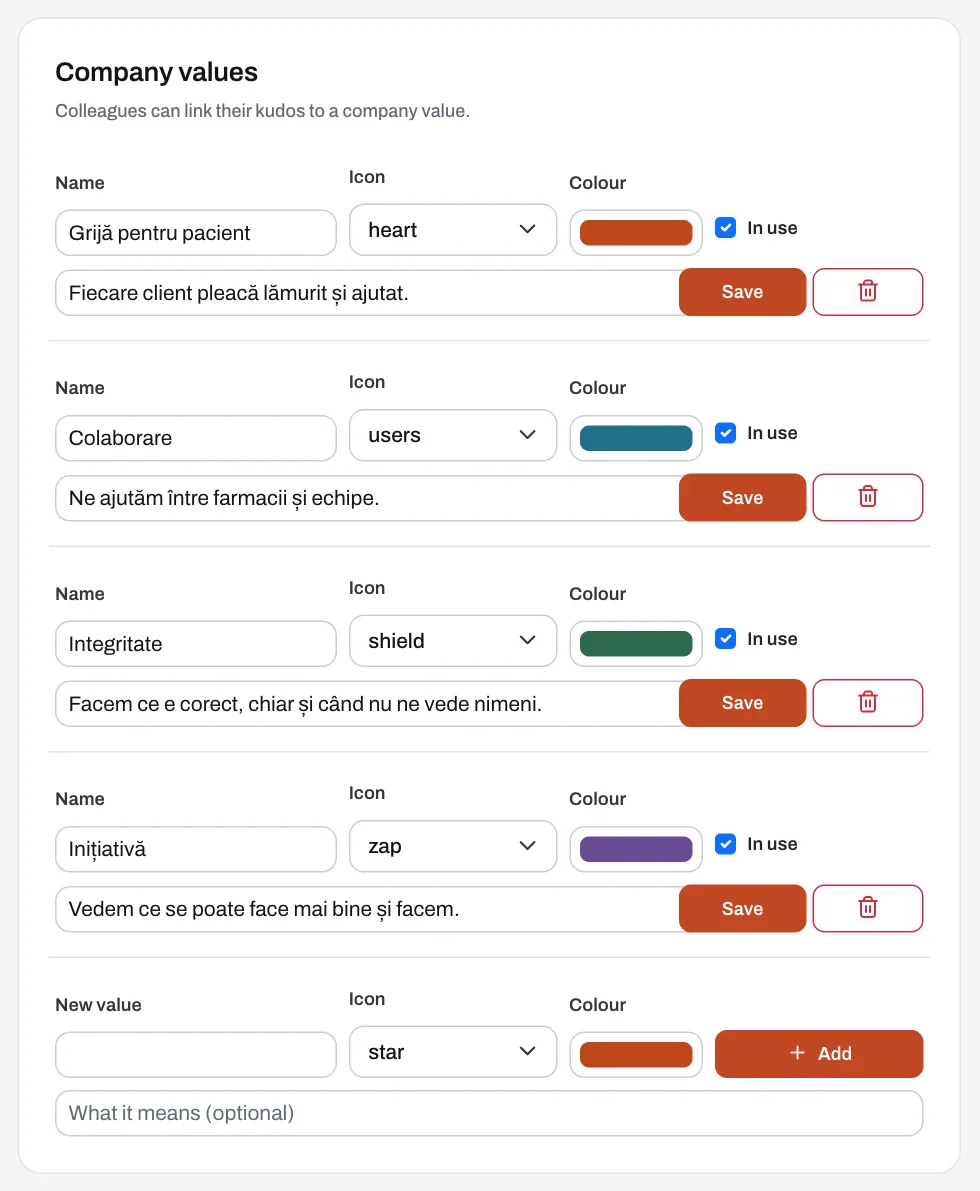
- The company’s values are defined under Social → “Social settings” by whoever has moderation rights: a name, a short description, an icon and a colour. A value can be retired without losing the old kudos.
- Kudos are given from the feed (“Kudos”) or from the colleague’s profile: whom you are thanking (up to 10 colleagues at once), for which value (optional) and why. Nobody can give kudos to themselves, and the people recognised receive a notification.
- Visibility: kudos are published in the company feed, for everyone. The app has no private kudos: for a thank-you in private, use a one-to-one conversation or, where they are switched on, direct messages.
- On the profile you can see the number of kudos a person has received and their split by value. Tell people this when you introduce the habit.
- As an indicator: “Kudos received” is calculated per unit, per department and per company, never per person. A team with no kudos in a period has 0, not “no data”.
- Celebrations are published automatically: a welcome for new colleagues, work anniversaries and birthdays — the latter only for those who choose to show their birthday, without the year.
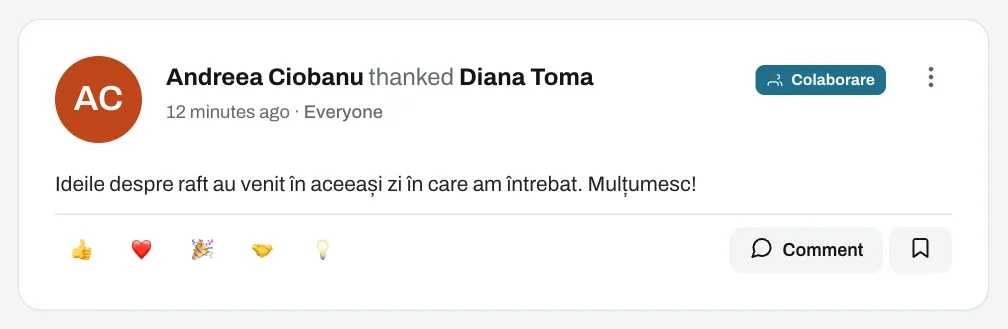
The feed can be filtered to kudos; on the Professional and Enterprise plans, every post has view and reaction statistics. There is no separate “adoption” dashboard for kudos.
Frequently asked questions
How often should kudos appear?
There is no right number. More important than frequency is that recognition is specific and comes from different teams.
Do managers have to approve kudos?
No. Approved recognition is no longer spontaneous. Inappropriate content is reported and moderated, like any post.
Can kudos be given to a whole team?
Yes, by mentioning the colleagues involved. For large projects, kudos for each concrete contribution say more than one general thank-you.
What do we do if someone never receives kudos?
It is not necessarily a signal about their performance. Look at how visible their role is and at the shift they work, and talk to their manager.
Next step
Write down your 3–5 values, each with one sentence, and ask the managers to give the first kudos following the four-element model. To see how it looks in the feed, go to the demo company.