

 Română
 English
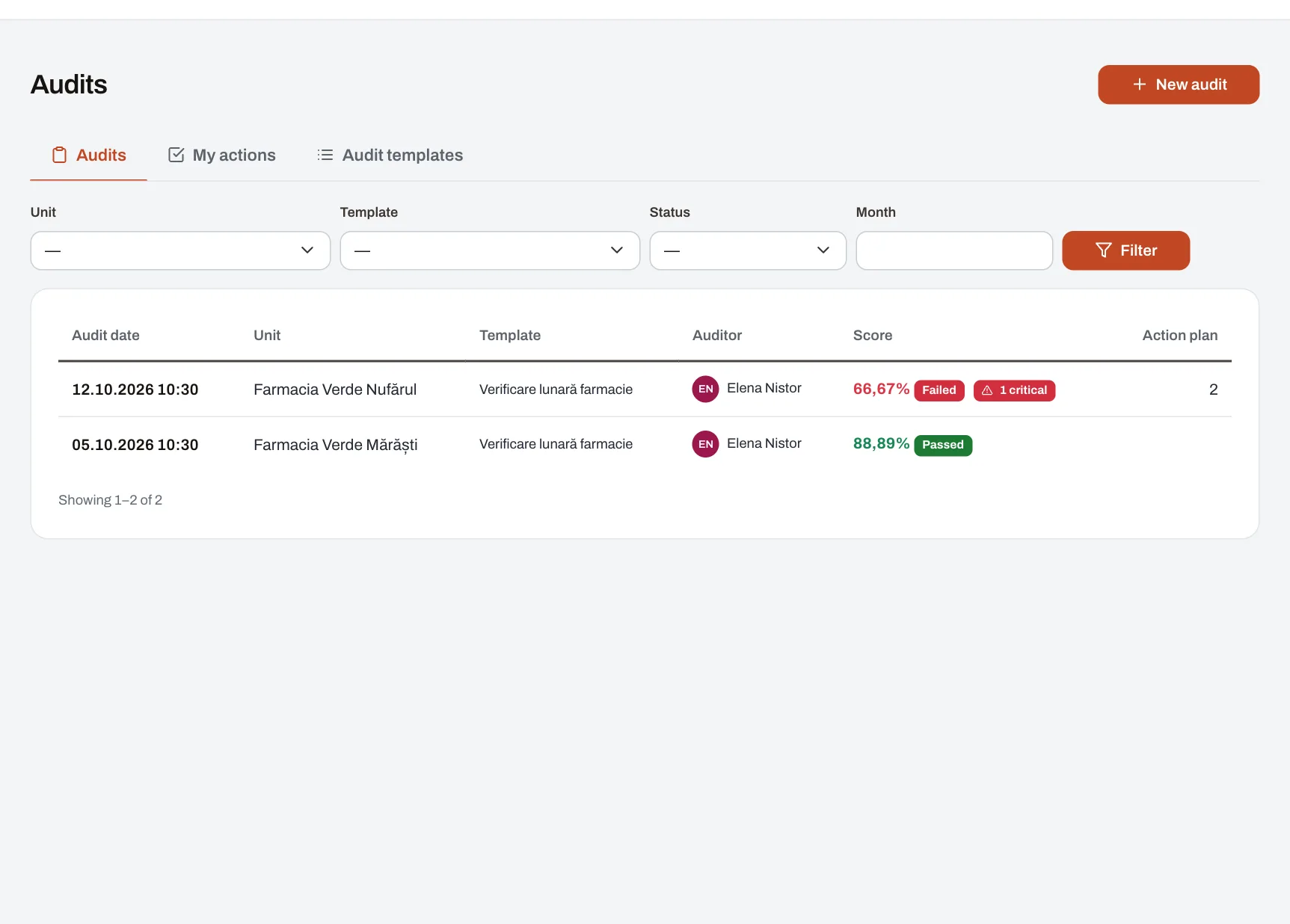
When you have many locations, internal audit is how you find out whether the company’s standard is kept the same everywhere. With Internal audit, auditors check units against lists the company makes, note on the spot, with photos, what is not right, and each finding can get a corrective action with an owner and a deadline. The score is calculated for you and can feed KPI scores. Auditors and area managers, unit managers and HR use it.
How it works
- Build the template. Sections with points to check, each with a weight and, where needed, marked critical. Choose the minimum passing score and whether a critical finding fails the audit whatever the score.
- The auditor starts the audit at a unit in their reach, with the date of the visit. The audit keeps its own copy of the points, so a later change to the template does not touch it.
- They rate each point: Compliant, Non-compliant or N/A. Each finding needs a comment and can have photos and the people involved, with their number of mistakes — only from those working in the unit on the day of the audit. They can save a draft and come back.
- They complete the audit once every point has an answer. The result: the score, the number of critical findings and Passed or Failed, and the unit’s managers are told. A completed audit can no longer be changed.
- The action plan. For a finding, the auditor or a manager who sees the results adds an action: what has to be done, the owner, the deadline. The owner sees it under “My actions” and marks it done with a note; the auditor confirms it or reopens it with a reason. An overdue action brings a single reminder, to the owner and to whoever created it.
How the score is calculated
The score is the weighted percentage of compliant points; N/A points do not count. An example from a chain of 40 convenience food shops: the “Hygiene and presentation” template has 20 points with a total weight of 40. In one shop, two points (weight 4) do not apply and three points (weight 6) are non-compliant, one of them critical — the allergen list is missing at the bakery counter. The score is 30 out of 36, that is 83.33%. The minimum is 80%, but the template says a critical finding fails the audit, so the outcome is Failed. The shop manager receives the action “Display the allergen list”, due in two days.
Who sees what
- The auditor: their own audits and those in the units in their reach.
- Managers allowed to see results: the audits of the units in their reach.
- An action’s owner: the audit their action belongs to.
- By default, unit and area managers audit; HR sees the whole company. Roles can be changed.
Audit and KPI
- Results can feed metrics: a unit’s average audit score, the number of critical findings, and the mistakes attributed to a person in the period’s audits.
- Only completed audits count; drafts do not.
- An audit by someone who works in the unit or manages it directly is marked a “Self-check” and never counts in the metrics.
Limits
- Audits are not scheduled in advance: the auditor starts one when making the visit.
- Each point is rated Compliant / Non-compliant / N/A, with weights; there are no graded scales.
Frequently asked questions
What happens to past audits if we change the template?
Nothing. Each audit keeps the points it started with; the change counts only for new audits.
Can a unit manager audit their own unit?
Yes, but the audit is marked a Self-check and does not count in the audit metrics.
How do I find the actions I have to fix?
“My actions” lists every action you own, with its deadline; you also get a notification when one is assigned to you.
Can I add photos to a finding?
Yes, on every point, straight from the phone.