

 Română
 English
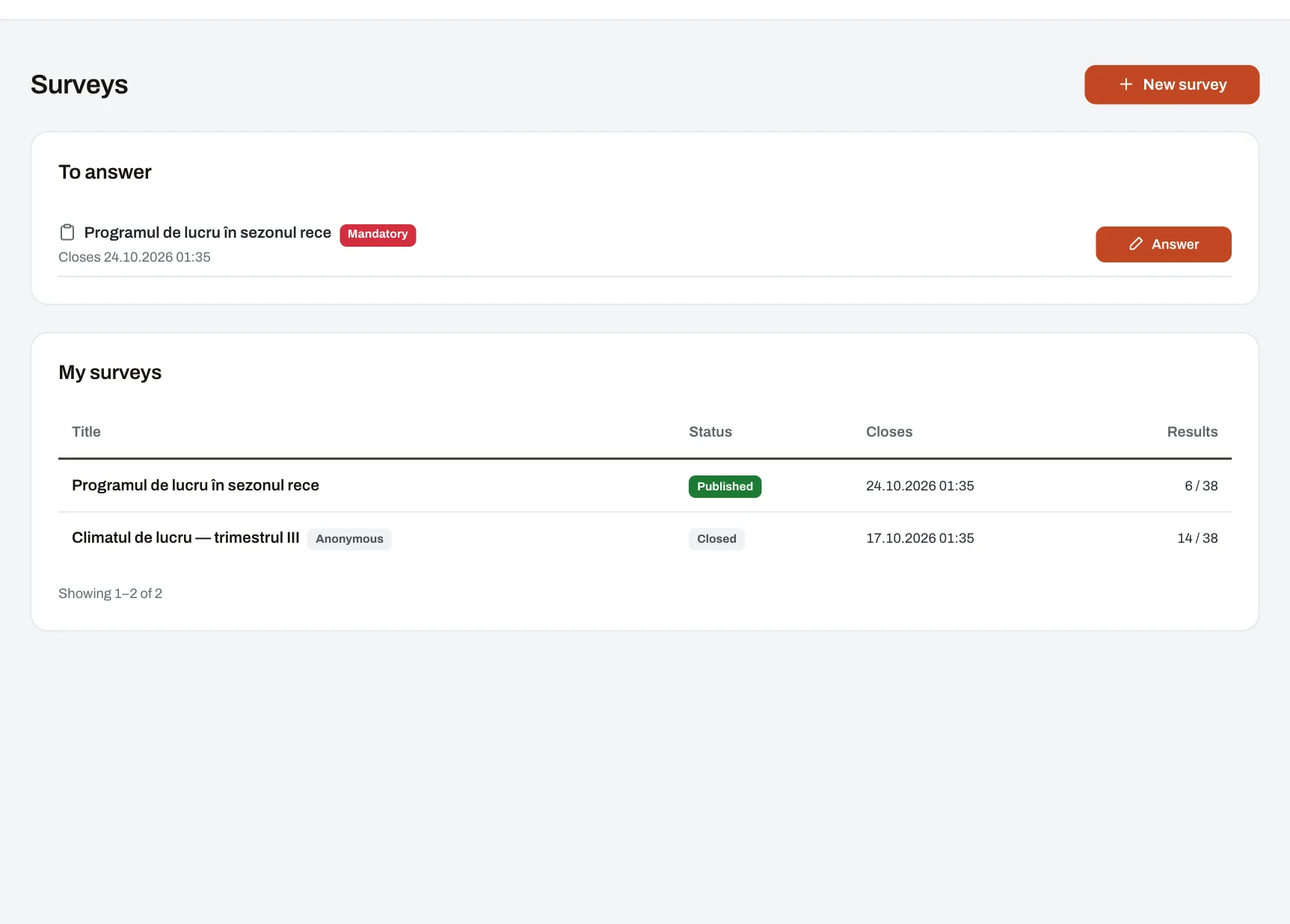
People say what they really think only when they are sure they cannot be recognised. Harmoniq’s surveys are built for that: in an anonymous survey the answers cannot be linked to a person — not by HR, not by anyone with access to the database. Use them for employee satisfaction, feedback after a change or a quick question to a team. HR writes them; the people you choose answer.
How it works
- Write the survey. An introduction and the questions: single choice, multiple choice, free text or a 1–5 scale, each required or not. Choose whether it is anonymous or named, whether it is mandatory, and when it opens and closes.
- Choose who it is for: the whole company or particular units, departments, positions or areas. Someone without company-wide reach can choose only people in their reach.
- Publish. The people are fixed at that moment, by their primary placement, and get a notification. From then on the questions do not change.
- People answer once. A mandatory survey shows as a banner until it is filled in, and those who have not answered get a reminder at most two days before it closes.
- The result, at closing: the number of answers for each option, the average on scales, and the free texts in random order. While it runs you see who has answered and who has not, but not what they answered.
How answers stay anonymous
- While the survey is open, Harmoniq records only that a person answered. The answers are kept sealed and encrypted, apart from the person.
- At closing, all the answers are written at once, shuffled. Nobody can link them to a person or to the time they were given.
- Until then there are no results, not even the number of answers: a count that goes up when someone answers could give them away.
- Results appear only from 5 answers up.
- Every survey tells people, before they answer, whether it is anonymous or named.
Example: a chain of 18 restaurants
After changing its shift pattern, a chain of 18 restaurants wants to know how people feel about it. HR sends an anonymous five-question survey to the waiting and kitchen staff in every restaurant, open for ten days. Along the way it sees that 140 of 210 people have answered and sends a reminder. At closing, 168 answers appear at once: the average for “The new pattern leaves me time to rest” is 3.1 out of 5, and the AI summary of the free texts shows the main themes — closing shifts and weekends.
Who sees what
- The author sees the results of their surveys.
- Anyone allowed to see results who has company-wide reach sees the results of every survey.
- The “who has answered” list shows only who answered, for the people in the viewer’s reach.
- In a named survey, the author also sees each person’s answers.
- Someone signed in as another person cannot answer on their behalf.
AI summary and KPI
- If the AI assistant is on, a summary of the text answers can be requested after closing: the main themes, with no quotes and nothing that could identify anyone.
- Participation can become a metric — “Survey participation” — for teams and the company, never for a person.
Limits
- Results are for the whole survey, not per unit, so that nobody can be recognised in a small team.
- An answer cannot be changed once sent, and a published survey’s questions cannot be edited.
Frequently asked questions
Can HR find out who answered what in an anonymous survey?
No. The answers are shuffled and written all at once at closing; there is no link between them and the people.
Why can’t I see results before it closes?
Because any figure that changes along the way would show who has just answered.
What if fewer than 5 people answer?
An anonymous survey’s results stay hidden, so that nobody can be identified.